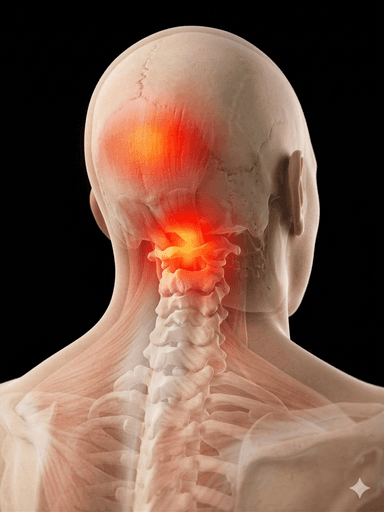
Headache · neck pain
- ·A stiff neck that is uncomfortable to turn
- ·Frequent headaches and a heavy nape
- ·A neck that won’t turn when you wake up
- ·An upper back that always feels knotted


Pain that doesn’t show on an MRI may come from the fascia. Obliv’s fascial therapy uses an oiling technique to reach the deep fascia gently, treating not the place that hurts, but the place that makes it hurt.
Headache · neck pain
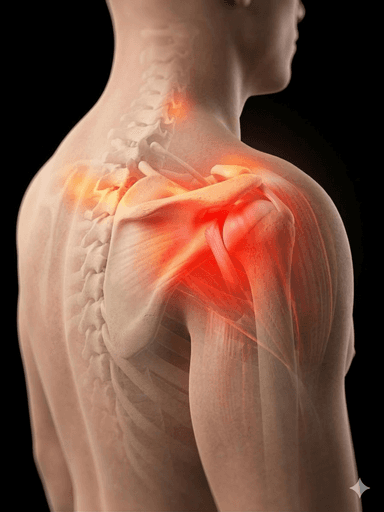
Shoulder pain
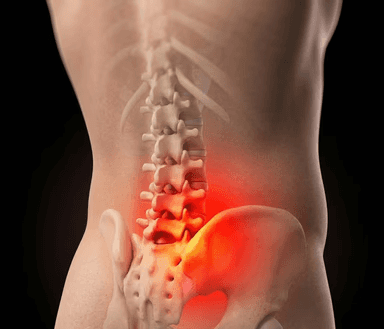
Lower back · pelvic pain
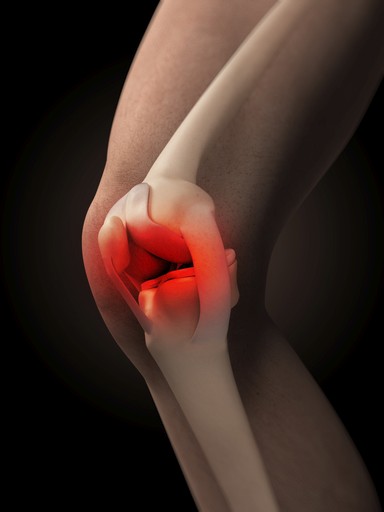
Arm · knee · foot pain
Why fascia?
~250 million
The number of nerve endings in the fascia. More than the skin (~200 million) — not mere wrapping material, but the body’s largest sensory organ.
— Robert Schleip, Technical University of Munich Fascia Research Project
The fascia is dense with pain receptors. When adhesions form, nerve endings are compressed and chronic pain follows.
This pain is hard to place (referred pain) — where it hurts and where it comes from are often different.
3 layers
Superficial · deep · visceral fascia
16 papers
Peer-reviewed evidence base
The truth about unexplained pain
MRI and CT cannot see the fascia.
Bones, cartilage and discs show clearly, but fascial adhesions are functional changes — they don’t register on standard imaging.
Conventional treatment centres on “structure”.
Orthopaedics focuses on abnormalities of bone and joint structure. If imaging shows nothing, you are judged “normal” — but functional problems in the fascia can only be confirmed by palpation and range-of-motion (ROM) assessment.
Where it hurts ≠ where it comes from (referred pain)
Pain carried by the fascia’s C fibres is hard to localise. If your shoulder hurts and only the shoulder is treated, the cause is missed. Obliv traces pain to its root.
Obliv's fascial therapy
The oiling technique — reaching the deep fascia
Oil is used not for comfort but for precision. With skin friction removed, the therapist’s force is carried straight to the deep fascial layers rather than the surface. After a preliminary assessment fixes the target, we release gently along the grain of the fascia.
Stecco Fascial Manipulation — tangential oscillation raises HA fluid pressure (Roman et al., JAOA, 2013)
Referred-pain tracing — treatment that finds the cause
We look for the place that makes it hurt, not the place that hurts. Rather than pressing only where the pain is, we trace the true cause along the fascia’s full network, guided by the anatomy.
Fascial C fibres → convergence on spinal dorsal-horn WDR neurons → the brain misreads the source of pain (Schilder et al., Pain, 2014)
State-certified physiotherapists throughout
Treatment is delivered 100% by nationally certified physiotherapists — specialists who understand the anatomy read your body and treat it. A female therapist treats you in a private room, so you can feel at ease.
22 individual treatment rooms across ≈660 m² — complete privacy
Combined treatment
Micro-mechanical stimulation → self-healing switched on
1,000–1,500 shockwaves prompt the release of growth factors (five kinds, including VEGF and PDGF) and encourage new blood-vessel formation, accelerating the regeneration of damaged tissue.
Effective for chronic pain
Where healing has stalled — chronic pain lasting over 3 months, calcific tendinitis, plantar fasciitis — it restarts the stalled recovery process.
Non-surgical · non-invasive
No incisions, no injections, no medication. Treatment takes 20–40 minutes, and you can return to your day straight afterwards.
→ Fascial therapy releases the adhesions and opens the blood-flow pathways
→ Applying shockwaves to the released tissue raises regeneration efficiency
→ Recovery is faster and lasts longer than either treatment alone
Objective verification
Measure before treatment
Joint movement is measured precisely. For example: “Currently 120 degrees. Normal is 180. Movement is restricted by 60 degrees.”
Fascial therapy
Guided by the measurements, we pinpoint the adhesions and release them gently along the grain of the fascia.
Measure again after treatment
The same measurement, repeated. For example: “155 degrees — a 35-degree improvement. As the adhesions released, the movement returned.”
The treatment process
Precise diagnosis · ROM assessment
The director’s examination and range-of-motion (ROM) measurement identify the root cause of the pain. Fascial adhesions that imaging cannot see are confirmed by palpation.
A personalised treatment plan
Considering your level of pain, age, build and lifestyle, we compose a tailored solution centred on fascial therapy — and decide whether to add extracorporeal shock wave therapy.
Fascial therapy
A nationally certified physiotherapist reaches the deep fascia with the oiling technique and releases the adhesions. Extracorporeal shockwave therapy is added where needed.
ROM re-measurement · aftercare
After treatment, ROM is measured again to confirm the improvement, with guidance on self-exercise and posture to help prevent recurrence.
Length of one session
Recommended frequency
Recommended course
* May vary with the treatment plan and individual condition.
Pain addressed at the root
Releasing adhesions in the deep fascia — not just the surface — reaches the root cause of pain
Self-recovery switched on
Encourages the body’s own healing capacity, without relying on injections or medication
Range of motion restored
Restoring fascial glide makes stiff joints move smoothly again
Non-surgical · non-invasive
No incisions, no injections — and back to your day straight after treatment
Recovery that lasts longer
Resolving the root cause of fascial adhesions helps the results hold longer and lowers recurrence
Fascial therapy releases the adhesions and opens the blood-flow pathways; extracorporeal shock wave therapy promotes regeneration of the damaged tissue. Applying shockwaves to tissue already released by fascial therapy raises regeneration efficiency — so recovery is faster and lasts longer than either alone. The medical team decides whether to combine them, according to your condition.
Each session lasts about 40–60 minutes, and we recommend a base course of 5–10 sessions at 1–2 per week. Change is checked at every session with ROM measurement, and the plan is adjusted to you.
We work with gentle pressure, so there is very little pain. Fascia has the property of tightening in defence the harder it is pressed — so gentle pressure actually produces deeper release. Straight after treatment you can feel the relief and the improved range of motion.
Oil is used for precision, not comfort. It is a treatment tool: reducing friction between skin and hand lets gentle contact reach the deep fascial layers. Pressed too hard, fascia tightens in defence — so a soft, oiled approach is what releases the deeper layers.
MRI and CT show bones, cartilage and discs well, but fascia is a thin, dynamic tissue that standard imaging does not capture. Fascial adhesion (densification) is a functional change rather than a structural one — it can be confirmed by palpation and ROM assessment.
Standard physiotherapy deals mainly with muscles and joints. Fascial therapy focuses on the fascia — the three-dimensional connective tissue wrapping and linking muscles, bones and organs. Obliv reaches the deep fascia with the oiling technique, and treats by tracing pain to its root cause (referred pain) rather than the painful spot alone.

Obliv Seoul Origin Doctors
Director
(Current) Director, Obliv Clinic Seoul Origin Branch
Graduated from Keimyung University School of Medicine

Park Hyun-soo
Director
View details ›
Obliv Seoul Origin
Main phone number
02-6956-3438
BodyLab (Rehabilitation Medicine) Clinic
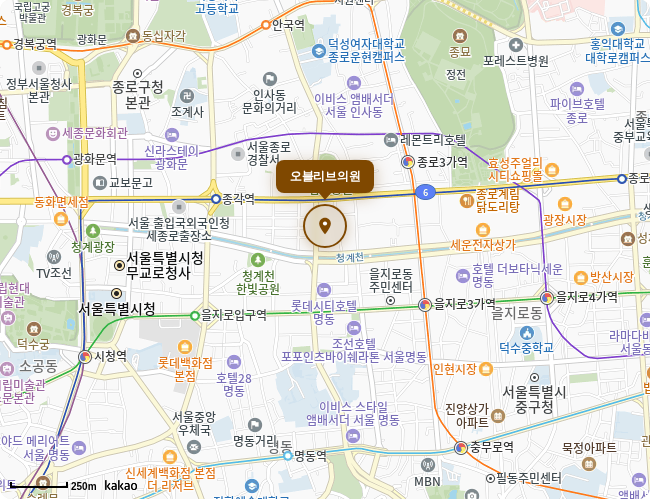
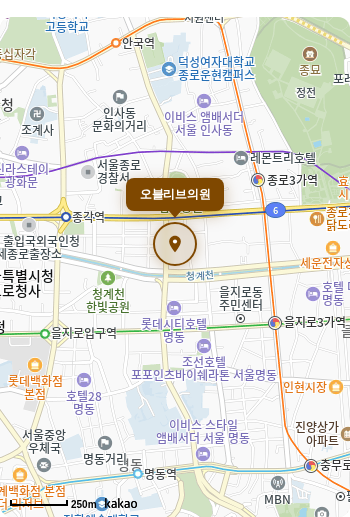
B1, Pagoda Tower, 93 Cheonggyecheon-ro, Jongno-gu, Seoul
From Jonggak Station
① Leave Exit 4 and go straight for 300 m ② With Daiso behind you, turn right (towards Samil-daero) ③ Go straight for 150 m towards Cheonggyecheon
From Jongno 3(sam)-ga Station
① Leave Exit 15 and go straight for 300 m ② With Burger King behind you, turn left (towards Samil-daero) ③ Go straight for 150 m towards Cheonggyecheon
From Euljiro 1(il)-ga Station
① Leave Exit 4 and go straight for 300 m ② With IBK Bank behind you, turn left (towards Samil-daero) ③ Go straight for 150 m towards Cheonggyecheon
From Euljiro 3(sam)-ga Station
① Leave Exit 1 and go straight for 150 m ② With Starbucks behind you, turn right (towards Samil-daero) ③ Go straight for 150 m towards Cheonggyecheon
Skin · Body · Scalp
Mon – Fri
10:00 - 21:00
Sat – Sun
10:00 - 19:00
BodyLab (Rehabilitation Medicine)
Mon – Fri
10:00 - 21:00
Saturday
10:00 - 19:00
Footcare · Nail
Mon – Fri
09:30 - 20:00
Saturday
09:30 - 19:00