
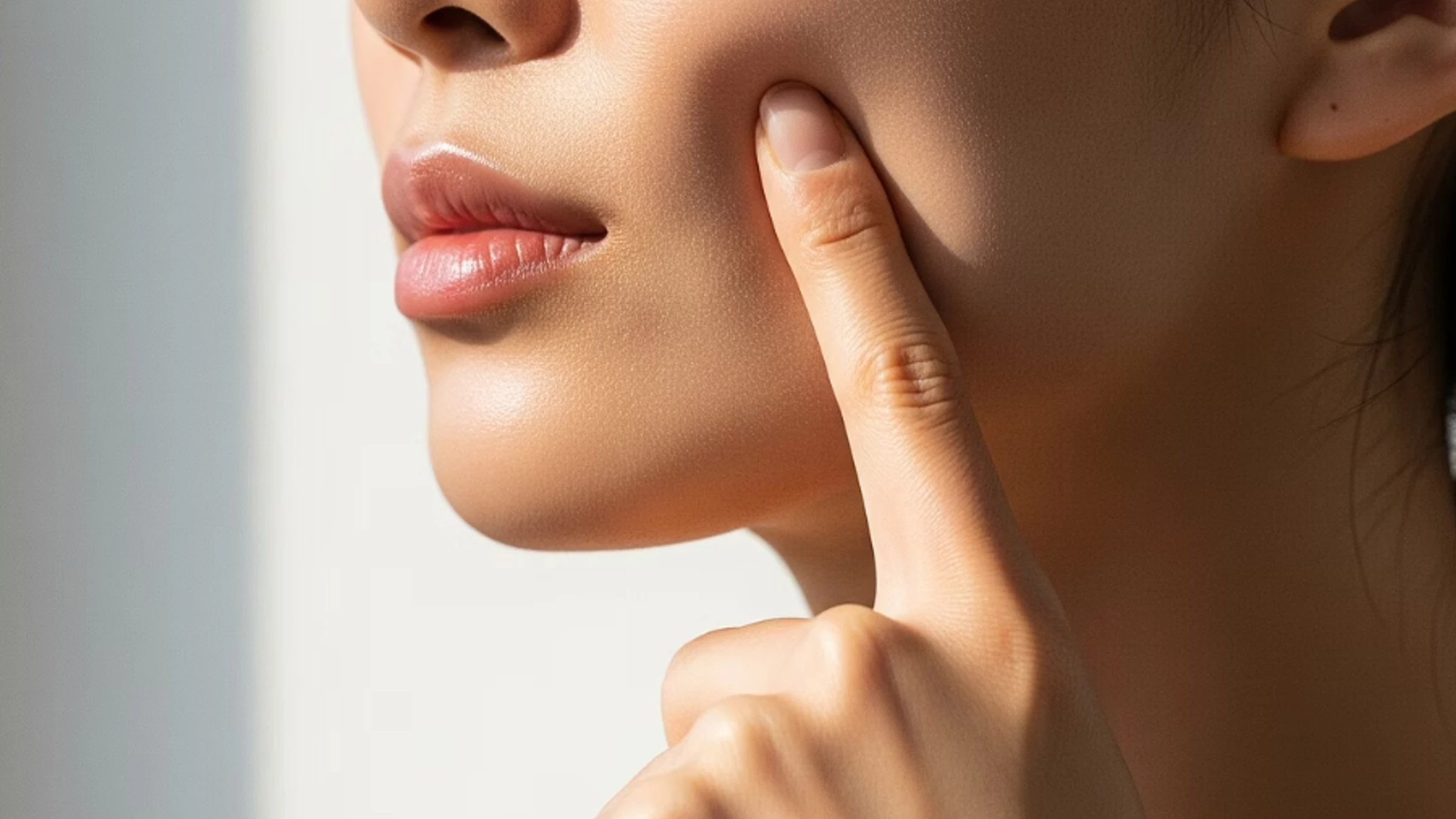
If plump cheeks in the mirror have you searching for 'injections for cheek fat', another worry tends to follow close behind: once the fat is gone, will your face look gaunt — or somehow older?
That worry is, in fact, rather good instinct. Depending on where it sits, there is cheek fat that brings your facial line to life when reduced — and cheek fat that hollows your look if touched carelessly. So today, rather than treating the cheek as one lump, let's take it step by step: which cheek fat should go, and which should stay.
Before any injections for cheek fat — each position has its own name
What we lump together as 'cheek fat' isn't actually one thing. Its role — and whether it can safely be reduced — changes with where it sits. Broadly, it divides into three.
| **Name** | **Where it sits** | **What it does** |
|---|---|---|
| Apple zone (front cheek) | Inside the cheekbone — the part that rounds when you smile | Volume that keeps you looking young — fat generally worth keeping |
| Deep cheek fat | Fat deep inside the cheek | In excess, makes the face look round and heavy |
| Jowls (lower cheek) | Below and beside the corners of the mouth | When it sags, lends a sullen, older look |
On the very same cheek, the apple zone up top is an asset that brightens your look, while the fat lower down adds heaviness. Reduce 'cheek fat' wholesale without knowing this difference and volume that should never have gone disappears with it, leaving the face drawn and older-looking. This is why cheek fat injections are not simply a treatment where the more you remove, the better.
There's a reason the fat behaves so differently from place to place. Facial fat isn't one continuous mass: it's divided into compartments by ligaments that act like partitions — rather like a chocolate bar scored into squares. So one compartment can be full and rounded while the one beside it is emptying, with different states side by side in a single face. Which is why cheek fat has to be read as several compartments, not one lump.
Plump cheeks and sagging cheeks have different causes
Cheek concerns fall into two broad camps. One is the fat type — cheeks that have always been full; the other is the sagging type — cheeks that used to be fine but have gradually settled downwards. They can look alike, yet call for opposite approaches.
Picture a balloon filled with air. Plump cheeks are a balloon with plenty of air inside — plenty of fat, in other words. Sagging cheeks are closer to a balloon that is emptying while the rubber, now stretched, slides downwards. The former suits an approach that reduces fat; with the latter, taking out more fat can actually make the hollows stand out and the grooves look deeper.
It also helps to know how the sagging type comes about. With age, the collagen and elastic fibres in the skin diminish, and the ligaments that held the fat compartments in place loosen too. As the straps supporting the upper compartments slacken, the same amount of fat drifts downwards and pools beside the corners of the mouth. That's why, past your mid-thirties, the most common picture is a mixed one — plumpness and sagging together.
So with cheek fat, the first question isn't how plump it is but why it looks the way it does. Cheeks that have settled over time often bring heaviness all the way down to the jawline, so reading our piece on double-chin fat-dissolving injections alongside will make the picture clearer. And if you're weighing up how much of the cheek to reduce and what to leave, the criteria for fat to remove and volume to keep in facial fat-dissolving injections are worth a look too.
Which kind are yours? A quick self-check
Before you visit a clinic, you can get a rough sense of direction in front of the mirror at home. Run through the checks below one by one.
- Tilt your head towards the ceiling and the cheek fullness visibly shrinks → **sagging** is likely playing a large part
- The cheeks stay rounded even with your head tilted up → the amount of **fat** is on the higher side
- There's a pinchable bulge beside the corners of your mouth even when you're not smiling → the **jowls (lower cheek)** are carrying the weight
- Fuller in the morning, settling by the afternoon → **puffiness** may be mixed in
Of course, this is only a rough steer. In practice, fat, sagging and puffiness are usually blended together, and weighing their exact share is a job for an examination — hands on the cheek, eyes on the skin layers. As a way of sorting out what to ask at your consultation, though, a self-check is plenty.
How Zero-Kalo Fit approaches cheek fat
Zero-Kalo Fit at Obliv Clinic Seoul Origin never reads the cheek as one lump. We keep the apple zone that keeps you looking young, and plan the entry points, depth and amounts around the deep cheek fat and lower cheek that create heaviness — the perspective Obliv calls Skin Architecture.
The cheek is a small area, close to the muscles and nerves of expression, so it needs an even more careful approach than broad body areas. The same injection gives a markedly different quality of result when it's placed after deciding what to leave and what alone to reduce — because the smaller the area, the more a fine difference in position shapes the whole impression. Add the mixed picture mentioned earlier — fat and sagging together — and a single method sometimes won't provide the answer on its own. Working out how much is the fat's doing and where the sagging takes over is, in that sense, a step that comes before the treatment itself.
Zero-Kalo Fit also goes a step beyond standard fat-dissolving injections: an evolved formula that concentrates the active ingredients at high strength, with a focus on keeping the treated area from readily filling back in. (Results and how long they last can vary with individual constitution and lifestyle.)
After cheek fat injections — while things settle naturally
The cheek does more expressive work than anywhere else on the face, so recovery runs a little differently here too. Right after the injections there may be some temporary swelling or a faint trace of bruising, which usually settles over a few days. During this time it's best to postpone anything that feeds the swelling — very hot saunas, vigorous massage and the like.
Rather than appearing all at once, the change tends to be a gradual tidying of the contour over several sessions — which is exactly why intervals are left between them. In an area this small and delicate, refining little by little as you watch progress protects the naturalness of your expression far better than reducing too much in one go. How you recover, how quickly, and how many sessions you need vary from person to person, and are settled together at consultation.
Cheek fat is about balance, not subtraction
Cheek fat treatment is less about removing a lot, and more about deciding what stays and what goes.
Even if full cheeks have long been a sore point, what actually needs to go is often not the whole cheek but the part that weighs your look down. Keeping the front cheek that keeps you young, and tidying only what makes the face look heavy — finding that point of balance is the heart of cheek fat treatment. And it always begins with a consultation that sorts out whether yours is fat, sagging or puffiness. The more self-conscious you have been about fullness, the more a 'right amount for my face' approach — rather than removing for its own sake — tends to lead to a result you're genuinely happier with.
Will injections for cheek fat slim my face?
When the deep cheek fat or lower cheek that creates heaviness reduces in volume, you can expect the cheek line to tidy up. If sagging or puffiness is the main cause, however, the change may be limited — which is why identifying the cause comes first.
Won't removing cheek fat make me look older?
It can, if the front-cheek (apple zone) volume that keeps you looking young is reduced too far. That's why positional planning matters: leave what should be kept, and treat only the areas that create heaviness.
How many sessions do cheeks need?
It depends on how much fat there is and how much sagging, so the number and spacing of sessions are adjusted at consultation. Because the area is small, refining it in stages while watching progress often looks more natural than removing a lot in one go.